
WPC Profiles
100% Waterproof WPC Decking: Why It Is the Ideal Choice for Outdoor Environments
WPC decking sold in Europe must meet the requirements of EN 15534, the standard for wood-plastic composites. The water resistance tests are particularly demanding.
Introduction: The Core Challenge of Outdoor Decking
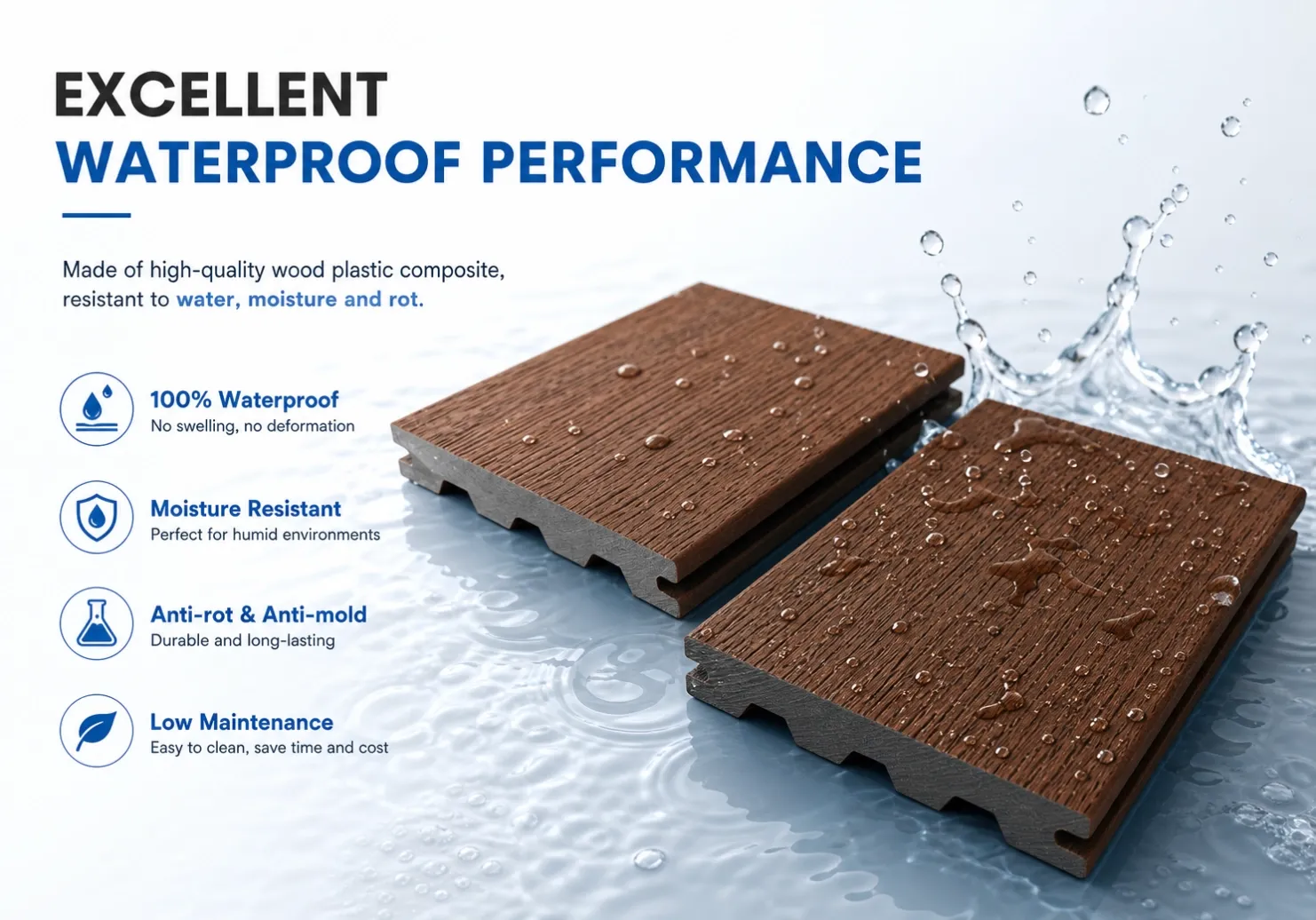
Outdoor decking faces a constant battle against moisture. Rain, humidity, morning dew, and temperature fluctuations all test the durability of any flooring material. Traditional wood decking absorbs water, leading to swelling, warping, cracking, and eventually rot.
WPC (Wood-Plastic Composite) decking was engineered to solve this problem. Its waterproof performance is not a marketing claim—it is a result of material science, manufacturing precision, and rigorous testing standards. This article explains how WPC decking achieves its moisture resistance and why it is the superior choice for outdoor spaces.
The Composition: Why WPC Resists Water
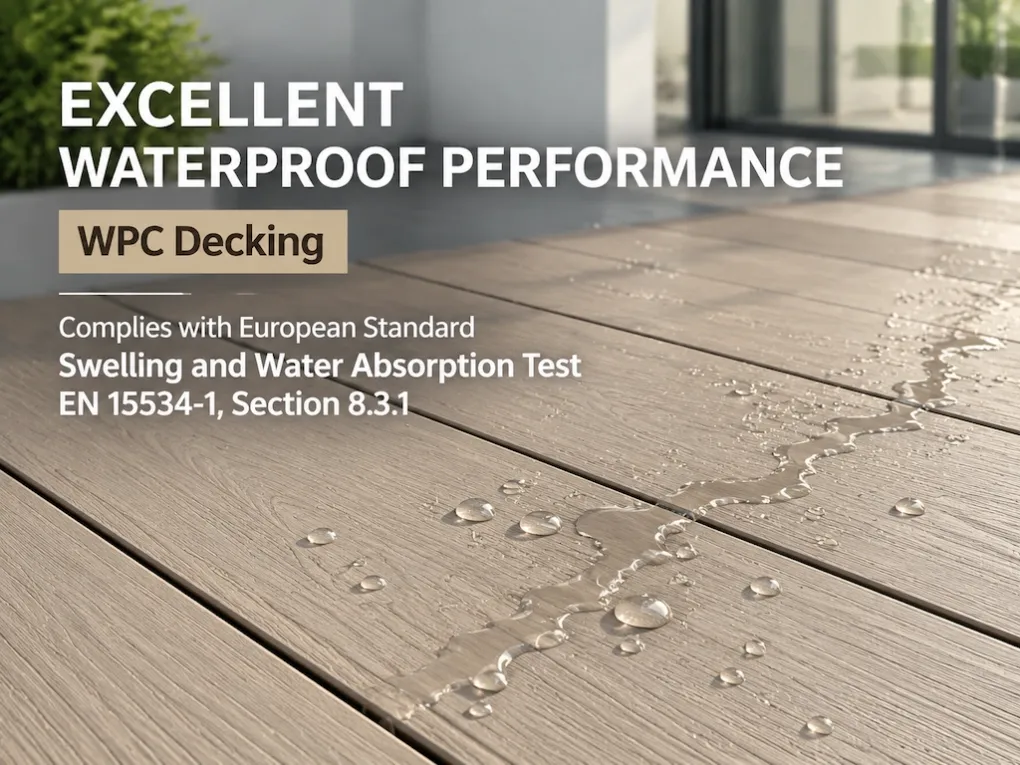
WPC decking is made from a carefully balanced blend of wood fibers and thermoplastic polymers such as polyethylene (PE), polypropylene (PP), or PVC . The typical ratio is approximately 50% wood content to 50% plastic, though formulations vary by manufacturer .
The key to waterproofing lies in the plastic component. Thermoplastic polymers encapsulate the wood fibers, forming a protective matrix that prevents water from penetrating the core. Unlike natural wood, which has open pores that absorb moisture, WPC has a closed, dense structure that repels water at the surface.
High-quality WPC decking can achieve a water absorption rate as low as 0.63% to 1.15% under standard testing conditions . For comparison, natural wood can absorb 20% or more of its weight in water.
The Manufacturing Process: Engineering Moisture Resistance
The production process further enhances WPC's waterproof capabilities.
Extrusion Technology
WPC decking is manufactured through extrusion, a process where the wood-plastic compound is heated and forced through a die to create continuous profiles . Twin-screw extruders ensure homogeneous mixing, precise thermal control, and uniform fiber distribution, resulting in a dense, consistent material with minimal internal voids .
Co-Extrusion: The Advanced Shield
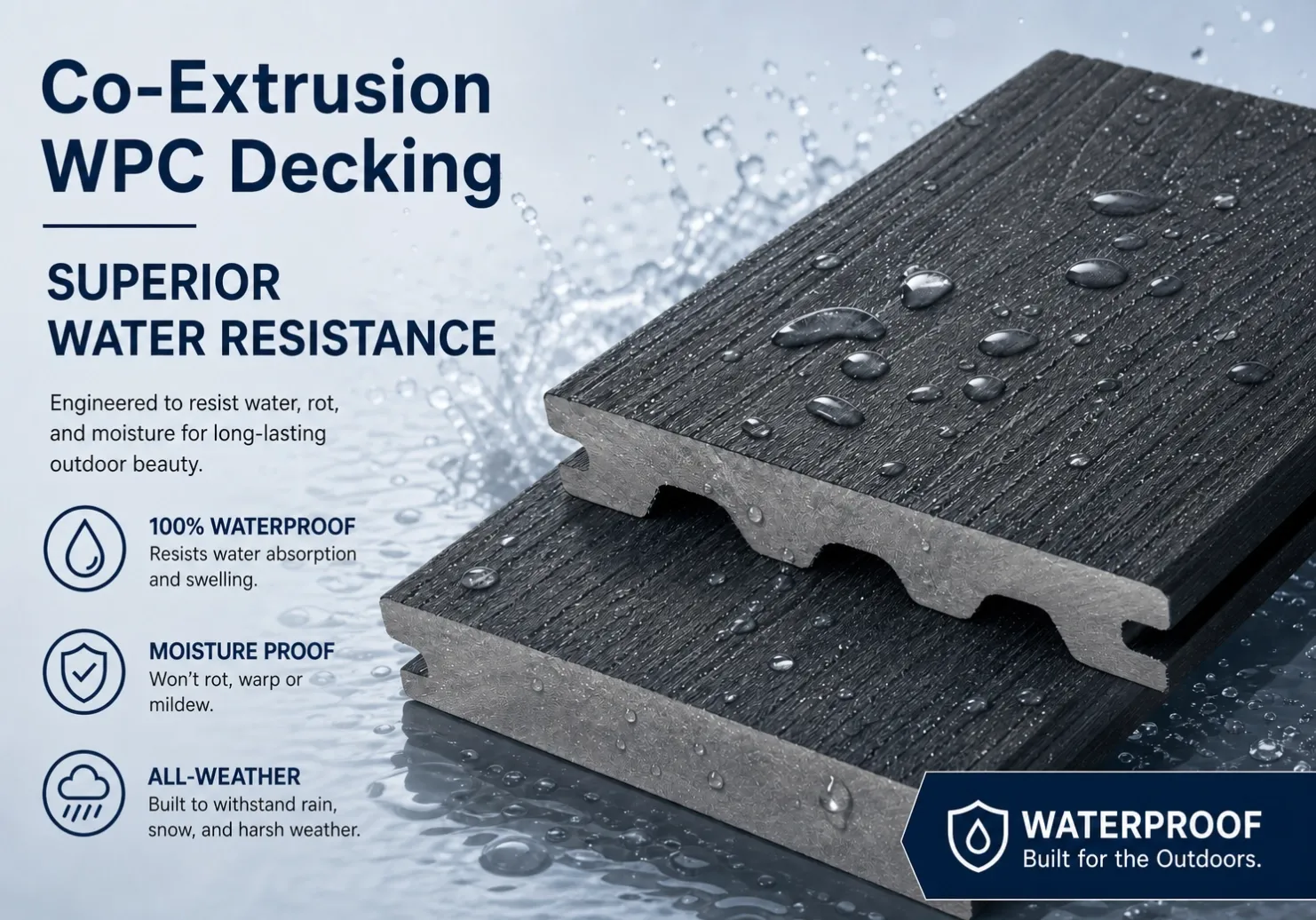
Many premium WPC decking products now use co-extrusion technology. This involves applying a protective polymer cap layer over the WPC core during manufacturing .
This outer layer acts as a 360-degree shield, preventing moisture, UV rays, and stains from reaching the core . The cap and core are hot-bonded during extrusion, creating a tight, inseparable bond that significantly extends the product's lifespan in wet conditions.
European Standards: Proving Waterproof Performance
WPC decking sold in Europe must meet the requirements of EN 15534, the standard for wood-plastic composites. The water resistance tests are particularly demanding.
Swelling and Water Absorption Test (EN 15534-1, Section 8.3.1)
Samples are immersed in water for 28 days. To pass, the material must meet these limits :
Property | Requirement |
|---|---|
Mean swelling in thickness | ≤ 4% |
Mean swelling in width | ≤ 0.8% |
Mean water absorption | ≤ 7% by weight |
Maximum individual water absorption | ≤ 9% by weight |
A high-quality WPC decking board might achieve a mean water absorption of only 4.32% and maximum swelling of 2.36% in thickness—well within the standard's requirements .
Boiling Test (EN 15534-1, Section 8.3.3)
This accelerated test subjects the material to boiling water, simulating years of harsh exposure. The same absorption limits (mean ≤ 7%, max ≤ 9%) apply . Products that pass this test demonstrate exceptional long-term moisture resistance.
These standards are not arbitrary. They ensure that WPC decking can perform reliably in use class 3 or 4 environments—outdoor applications exposed to weather and moisture .
Applications: Where Waterproof Performance Matters Most
The waterproof nature of WPC decking makes it suitable for demanding outdoor environments:
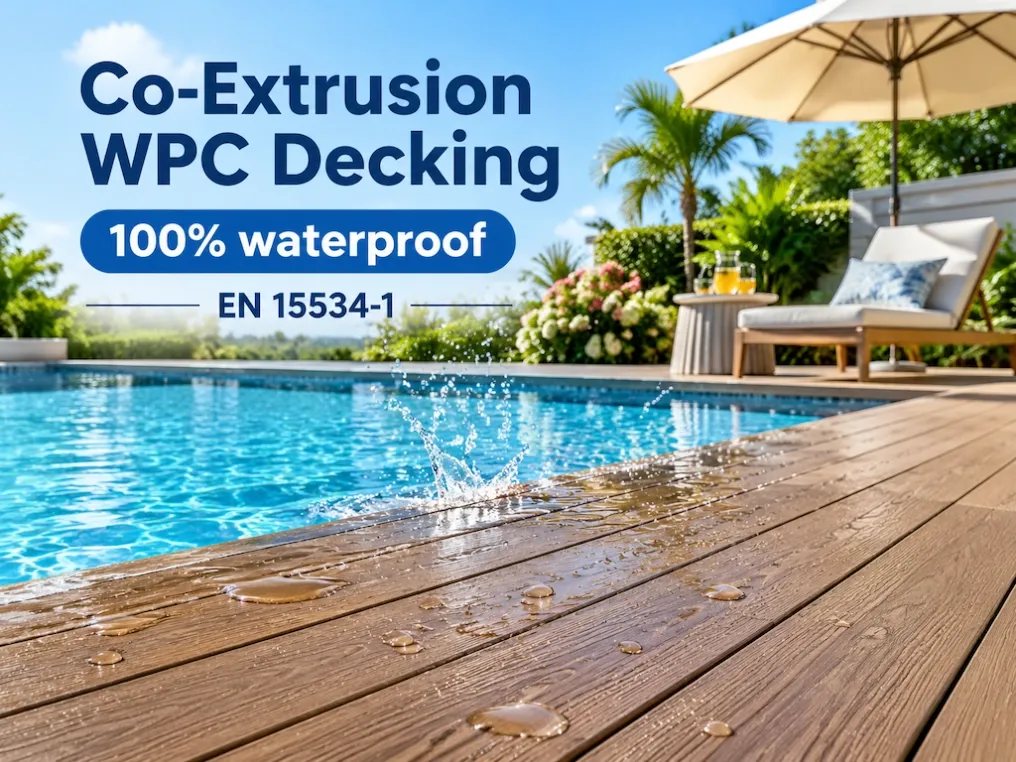
- Pool surrounds and spa areas – Constant splashing and wet feet are no problem
- Lakeside and riverside promenades – Resists humidity and occasional flooding
- Coastal properties – Withstands salt spray and high humidity
- Rainy climates – No swelling or warping during monsoon seasons
- Garden patios and balconies – Safe, dry surface even after rain
Beyond waterproofing, WPC decking offers a slip-resistant surface that remains safe when wet, making it ideal for family homes and public spaces .
About Yongtech: Your Professional WPC Manufacturer
Yongtech is a leading manufacturer of Wood-Plastic Composite (WPC) products, specializing in outdoor decking, fencing, and landscaping materials.
Our WPC decking is produced with advanced extrusion technology, including co-extrusion options with protective cap layers for enhanced waterproofing and UV resistance. We maintain strict quality control to ensure our products meet international standards for durability and performance.
Whether you are planning a residential patio, a commercial terrace, or a municipal project, our team can provide material recommendations, technical data, and design support.
Contact us today to discuss your outdoor decking requirements and request samples or a quotation.